

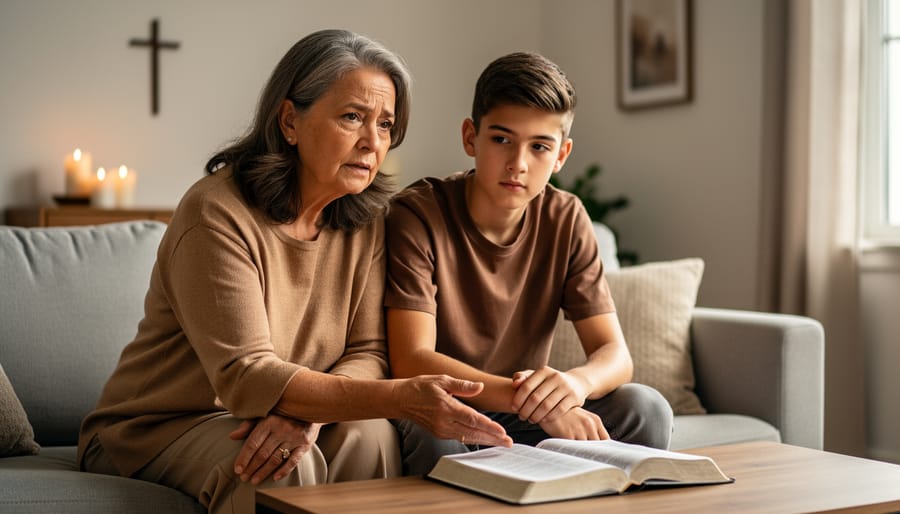
When parents withdraw from guiding their children through challenging cultural and spiritual questions, they don’t create neutral space. They create a vacuum that other voices will fill. This absence of parental engagement, particularly around topics that intersect faith and modern life, leaves young believers navigating critical decisions without the biblical foundation they desperately need. The consequences ripple through families and churches: children adopt worldviews shaped by peers, media, and popular opinion rather than Scripture, and they often interpret parental silence as either approval or irrelevance.
The pattern is alarmingly common in Christian homes today. Parents who faithfully bring their children to church and model prayer at meals sometimes fall silent when conversations turn difficult. They avoid discussions about complex ethical issues, cultural pressures, or personal choices that require nuanced biblical thinking. This retreat happens for understandable reasons: fear of saying the wrong thing, uncertainty about their own theological grounding, or simply exhaustion from the demands of modern parenting. Yet the cost is steep. Without active parental guidance rooted in Scripture, children lose the opportunity to see faith applied to real-world challenges. They miss the modeling of how to wrestle with difficult questions while remaining anchored in biblical truth.
The mandate for parents to teach and disciple their children threads throughout Scripture, from Deuteronomy’s call to speak of God’s commands “when you sit at home and when you walk along the road” to Paul’s instruction to bring up children “in the training and instruction of the Lord.” Parents are called to preach and equip within their own households, shaping the next generation’s spiritual formation. This article examines why parental guidance falters, what spiritual and practical dangers emerge in its absence, and how parents can reclaim their God-given role with confidence and biblical authority.
The Spiritual Void: What No Guidance Really Means

Scripture establishes parents as the primary spiritual educators of their children. Deuteronomy 6:6-7 commands believers to impress God’s commandments on their children, talking about them “when you sit at home and when you walk along the road, when you lie down and when you get up.” This isn’t occasional instruction but continuous discipleship woven into daily life. Proverbs 22:6 reinforces this mandate: “Train up a child in the way he should go; even when he is old he will not depart from it.” The Hebrew word for “train” implies intentional dedication and consecration, not passive hope.
When parents offer no guidance, they create more than an information gap. They leave a spiritual void where biblical truth should anchor decision-making. Children don’t pause their development waiting for parents to engage. They absorb values, form convictions, and make choices based on whatever voices fill the silence, peers, influencers, marketers, or their own limited understanding.
No guidance manifests in several forms. Some parents practice complete silence, never initiating conversations about emerging issues like CBD use. Others deflect with vague statements: “Just be smart about it” or “Do what feels right.” Still others avoid the topic entirely, hoping their child won’t encounter the decision or will somehow intuitively know the right path. Each approach communicates the same message: this matter isn’t important enough for us to address together, or I don’t have wisdom to offer you.
This abdication disconnects families from Scripture-based frameworks at precisely the moment children need them most. When a teenager hears classmates discussing CBD for anxiety or sees advertisements promising wellness benefits, they’re facing a genuine moral and health decision. Without parental engagement rooted in biblical principles of body stewardship, wisdom, and discernment, they default to secular reasoning or pragmatic experimentation.
The spiritual vulnerability this creates extends beyond a single choice about CBD. Children learn that faith doesn’t speak to real-world dilemmas, that parents either don’t care or don’t know, and that spiritual authority stops at church doors. This mirrors the broader challenge facing Christian families: equipping the next generation requires both theological education and the courage to apply timeless truth to contemporary questions. When parents remain passive, they forfeit their God-given role as the interpreters of life through a biblical lens, leaving their children to navigate complex decisions without the anchor of scriptural wisdom or the safety of trusted counsel.
Consequences When Christian Parents Remain Silent on CBD
Formation of Secular Rather Than Biblical Worldviews

When Christian parents remain silent on CBD and other wellness trends, children naturally turn to the loudest available voices, and those voices rarely align with Scripture. Social media influencers present CBD as a harmless lifestyle upgrade, peer groups normalize experimentation, and commercial marketing frames these products through the lens of self-care and personal autonomy rather than stewardship and obedience to God.
Without a biblical framework for evaluation, young people absorb secular assumptions: that personal experience trumps wisdom, that feeling good justifies any choice, that the body belongs entirely to the self. They learn to ask “Does this work?” instead of “Does this honor God?” They measure decisions by testimonials rather than truth.
This formation happens gradually. A teenager scrolls past CBD gummies advertised for stress relief. A college student hears classmates praise its benefits. Each exposure reinforces a worldview where pleasure, convenience, and popular opinion form the foundation for moral choices. By the time parents speak up, competing voices have already shaped how their child thinks about body, health, and authority. The absence of Christian guidance doesn’t leave a vacuum, it guarantees secular discipleship will fill the space.
Health and Safety Risks of Uninformed Decisions

Without parental wisdom, adolescents face serious physical risks in an unregulated CBD market. Young people drawn to trendy gummies or vapes rarely verify product contents, exposing themselves to mislabeled CBD products that contain higher-than-advertised THC levels, heavy metals, or pesticides. These contaminants can trigger unexpected psychoactive effects, allergic reactions, or long-term harm to developing brains.
Teens also lack awareness of CBD’s interaction with common medications. Cannabidiol inhibits liver enzymes that metabolize antidepressants, birth control, and anti-seizure drugs, creating drug-drug interaction risks that can reduce medication efficacy or amplify side effects. A sixteen-year-old experimenting with CBD oil while taking prescription acne medication or asthma inhalers has no framework to anticipate these dangers without parental guidance.
Age-inappropriate dosing compounds the problem. Without a parent’s discernment, children may consume adult-strength products or use CBD to self-medicate anxiety or insomnia, masking underlying issues that require professional care. Silence leaves them vulnerable to trial-and-error experimentation with their own bodies as the testing ground.
Breakdown of Parent-Child Trust and Communication

When parents consistently avoid conversations about challenging topics like CBD, children internalize a painful message: “My parents either don’t care enough to engage or don’t know enough to help.” This perception, whether accurate or not, fundamentally alters the relational dynamic that should anchor Christian discipleship within the home.
Silence creates distance. Adolescents and young adults facing real questions about wellness, peer pressure, and personal autonomy naturally turn to whoever seems willing to engage. When parents abdicate, children replace them with friends, influencers, or online communities, sources that lack both covenant commitment and biblical authority. The family ceases to function as the primary venue for spiritual formation, becoming instead a household of coexistence rather than discipleship.
This breakdown extends beyond CBD to all areas of moral and spiritual guidance. Children learn that certain subjects are off-limits, that vulnerability is unwelcome, or that Mom and Dad are simply irrelevant to the real decisions of life. The erosion is gradual but devastating: parents forfeit their God-given shepherding role, and children lose the irreplaceable benefit of wisdom rooted in love, Scripture, and intimate knowledge of their hearts.
Why Parents Avoid Providing Guidance on CBD
Understanding why Christian parents hesitate to guide their children through CBD decisions reveals barriers rooted in genuine uncertainty rather than willful neglect. These obstacles, while understandable, ultimately leave children vulnerable at a critical moment when they need wisdom most.
The knowledge gap presents the most common barrier. Many parents encounter CBD through headlines and advertisements but lack substantive understanding of what it is, how it differs from marijuana, its legal status, or its medical applications. This unfamiliarity breeds paralysis, parents fear saying something factually wrong or appearing ignorant to their tech-savvy children who’ve already researched the topic online. The discomfort of admitting “I don’t know” feels particularly acute when parents believe they should function as authoritative guides.
Fear of legalism creates another significant obstacle, especially among parents who grew up in restrictive religious environments. They’ve witnessed or experienced the damage of rule-centered Christianity that majored on prohibition and minored on grace. Now, when facing new wellness trends, they overcorrect by staying silent rather than risk being perceived as judgmental Pharisees. The pendulum swings from rigid control to hands-off avoidance, bypassing the biblical middle ground of informed, loving leadership.
Parents frequently cite these specific concerns when explaining their reluctance:
- “I don’t understand CBD well enough to have an informed conversation”
- “I’m afraid my child will think I’m being old-fashioned or close-minded”
- “The Bible doesn’t mention CBD, so I’m unsure what Scripture says”
- “I don’t want to damage our relationship by seeming controlling”
- “My spouse and I disagree about it, so we’ve avoided the topic”
- “I’m concerned about appearing hypocritical given my own choices”
Cultural pressure compounds these personal fears. Society increasingly frames wellness decisions as individual rights that parents shouldn’t question, particularly for older teens. Parents absorb messaging that suggests guidance equals intrusion, that supporting children means endorsing their autonomy unconditionally. This cultural script redefines loving parental involvement as oppressive meddling.
Generational discomfort also plays a role. Parents who never discussed supplements, mental health, or body stewardship with their own parents lack conversational templates. Wellness wasn’t a dinner-table topic in many Christian homes, so initiating these discussions feels foreign and awkward.
These barriers are real, but they aren’t insurmountable. Recognizing them honestly is the first step toward the courage and humility required to engage anyway.
The Biblical Model: Active, Informed, Grace-Filled Parenting
Scripture offers a compelling alternative to parental passivity: intentional leadership that combines truth, wisdom, and relational warmth. This model rejects both extremes, neither the abdication of responsibility nor heavy-handed authoritarianism, in favor of discipleship that equips children to navigate complex decisions through a Christian worldview. When parents engage proactively with issues like CBD, they fulfill the mandate of Ephesians 6:4 to bring up children “in the training and instruction of the Lord,” creating space for genuine conversation rather than fearful silence.
Active parenting begins with parents educating themselves first. You cannot guide what you do not understand. This means learning the medical facts about CBD, its uses, risks, legal status, and age-appropriate applications, alongside developing theological clarity about body stewardship (1 Corinthians 6:19-20) and the pursuit of wisdom (James 1:5). The goal is not to become an expert in cannabis science but to acquire enough knowledge to ask good questions and discern legitimate therapeutic use from trendy experimentation. Parents who invest time in understanding both Scripture and the substance model the humility and diligence they want their children to practice.
Informed parents then create dialogue, not monologue. Jesus taught through questions, stories, and real-life application, and biblical teaching on parenting follows this relational pattern. Rather than issuing pronouncements, effective parents ask, “What have you heard about CBD?” or “How would you evaluate whether something is wise for your body?” These conversations invite children into the discernment process, teaching them to weigh evidence, consider motives, and apply biblical principles of self-control and submission to lawful authority. The parent’s role shifts from gatekeeper to guide, helping young people develop the internal compass they will need throughout life.
Grace-filled leadership also means admitting uncertainty while maintaining conviction. Parents can say, “I am still learning about this, but here is what Scripture makes clear about our bodies and decision-making.” This honesty builds credibility. Children respect parents who acknowledge complexity while holding firm to biblical principles. The framework is not “CBD is always wrong” or “CBD is always fine,” but “Let’s evaluate this together through the lens of stewardship, wisdom, legality, and love for God and neighbor.” That process-oriented approach equips children far better than a simple rule that may not apply in every future context.
Practical Steps to Move from No Guidance to Intentional Leadership
Moving from silence to confident, biblical leadership on CBD and wellness decisions requires intentionality, but the path is accessible for any parent willing to start. Here’s a sequential approach that transforms passivity into proactive discipleship:
- Educate yourself first. Spend time understanding what CBD is, how it differs from marijuana, its legal status in your state, the science on benefits and risks, and common products teens encounter. Read medical sources, not just marketing claims. You can’t guide what you don’t understand.
- Build a biblical framework for evaluation. Study passages on stewardship of the body (1 Corinthians 6:19-20), wisdom and discernment (Proverbs 4:7), self-control (Galatians 5:22-23), and submission to authority (Romans 13:1-7). Ask: How do these principles apply to wellness choices? What questions should we ask before using any substance?
- Pray for wisdom and the right timing. Ask God to prepare both your heart and your child’s heart for conversation. Pray for humility to admit what you don’t know and courage to lead anyway. This isn’t a one-time talk but an ongoing dialogue, begin prayerfully.
- Initiate age-appropriate conversations. For younger children, discuss body stewardship and making wise choices about what we put in our bodies. For teens, engage directly: “I’ve been learning about CBD and want to hear your thoughts. Have your friends talked about it?” Frame it as dialogue, not interrogation.
- Model discernment out loud. Let your children see you research, pray, and wrestle with decisions. If you’re considering a wellness product, say, “I’m going to check what’s in this and pray about whether it honors God’s design for my body.” Your process teaches more than your conclusions.
- Establish family guidelines together. Develop clear, grace-filled boundaries rooted in Scripture and your family’s values. Example: “We’ll only consider legal products, we’ll research ingredients and sources, and we’ll pray together before making decisions about our health.” Include your children in the process so they own the principles, not just comply with rules.
- Revisit and adjust as they mature. Guidance for a 12-year-old differs from guidance for a 19-year-old. As children grow, shift from directive authority to consultative wisdom. Keep the conversation open, update guidelines as needed, and celebrate their growing discernment.
This process isn’t about perfection. You’ll make mistakes, face questions you can’t answer, and navigate disagreements. That’s normal. The goal is faithful presence, not flawless expertise. Your willingness to engage, learn alongside your children, and point them to Christ matters far more than having every answer memorized.
Start small if the prospect feels overwhelming. Pick one step this week. Read a credible article about CBD. Pray with your spouse about when to bring it up. Ask your teenager a single open-ended question over dinner. Momentum builds as you move from intention to action, and the Holy Spirit provides wisdom as you seek it (James 1:5). Your children need your leadership, imperfect as it may feel, far more than they need your silence.
Common Questions Christian Parents Ask About Providing CBD Guidance
How do I start a conversation about CBD if I’ve been silent until now?
Begin with humility and honesty: acknowledge that you haven’t addressed this topic before and explain that you want to learn together as a family. Frame the conversation as part of your responsibility to help them navigate wellness decisions with biblical wisdom, not as a sudden crackdown.
What if my child is already using CBD?
Respond with grace before rules. Ask questions to understand why they chose CBD, what they hope it accomplishes, and where they got their information. Use this as a discipleship moment to teach discernment about body stewardship, product safety, and seeking wisdom from Scripture and trusted authorities rather than social media.
How do I balance grace and truth when setting boundaries?
Truth without grace becomes legalism; grace without truth becomes permissiveness. Clearly communicate biblical standards for self-control, body stewardship, and obedience to governing authorities while listening with compassion to your child’s questions and struggles. Let your guidelines reflect both conviction and love.
What if my spouse and I disagree about CBD?
Avoid presenting a divided front to your children. Take time privately to study Scripture together, pray, and seek counsel from pastoral leaders or trusted mentors. If you cannot reach full agreement, establish baseline safety rules you both support while continuing to work toward unity in your approach.
These scenarios surface repeatedly in Christian homes because CBD sits at the intersection of rapidly changing cultural norms, evolving legal frameworks, and timeless biblical principles. The questions reflect not parental failure but the normal challenge of applying Scripture to issues previous generations never faced. The key is moving from paralysis to prayerful action.
When guiding adult children, the dynamic shifts from authority to influence. You cannot enforce rules, but you can share your biblical convictions, express concerns rooted in love, and model the kind of thoughtful discernment you hope they will apply. Ask permission to speak into their decision rather than demanding compliance, and recognize that adult children may legitimately reach different conclusions within the bounds of Christian freedom.
Parents who lead congregations or serve in ministry roles face additional pressure. The principles of ecclesial leadership apply at home first. If you cannot shepherd your own household with wisdom and grace on contemporary issues, your credibility in guiding the broader church diminishes. Your family becomes your primary discipleship laboratory where biblical authority, compassionate listening, and humble learning converge.
The common thread in all these questions is the need for courage. Parental guidance on CBD requires you to step into discomfort, admit what you don’t know, and lead anyway. That is precisely the kind of faith-driven leadership Scripture calls parents to embody.
Parental silence on CBD and other emerging issues isn’t neutrality, it’s a decision to let culture, commerce, and peer influence disciple your children instead of Scripture. When Christian parents step back from guidance, they don’t create freedom; they create a vacuum that secular voices eagerly fill. The consequences extend beyond individual health choices to shape how the next generation understands authority, wisdom, stewardship, and discernment itself.
God has entrusted parents, ministry leaders, and theological educators with the privilege of shepherding souls through complex decisions. This responsibility doesn’t require perfect knowledge of every trend or chemical compound. It requires humble willingness to learn, pray, and engage, to model the process of bringing every question under the lordship of Christ. When you equip a young person to evaluate CBD through the lens of biblical wisdom rather than Instagram testimonials, you’re teaching them a discernment framework that will serve them in countless future decisions.
The CBD conversation is ultimately a discipleship opportunity. It’s a chance to demonstrate that faith applies to body stewardship, that Scripture speaks to real-world dilemmas, and that community discipleship extends into every corner of life. Don’t let fear or uncertainty keep you from the sacred work of guidance. Your children need you to lead, not with all the answers, but with the courage to seek them together in light of God’s Word.